
Sonnenglas Bamboo Lantern
Japanese tradition. Light from Africa.
The Bamboo Lantern
An andon lantern from Shizuoka. A SOMO from Johannesburg inside.
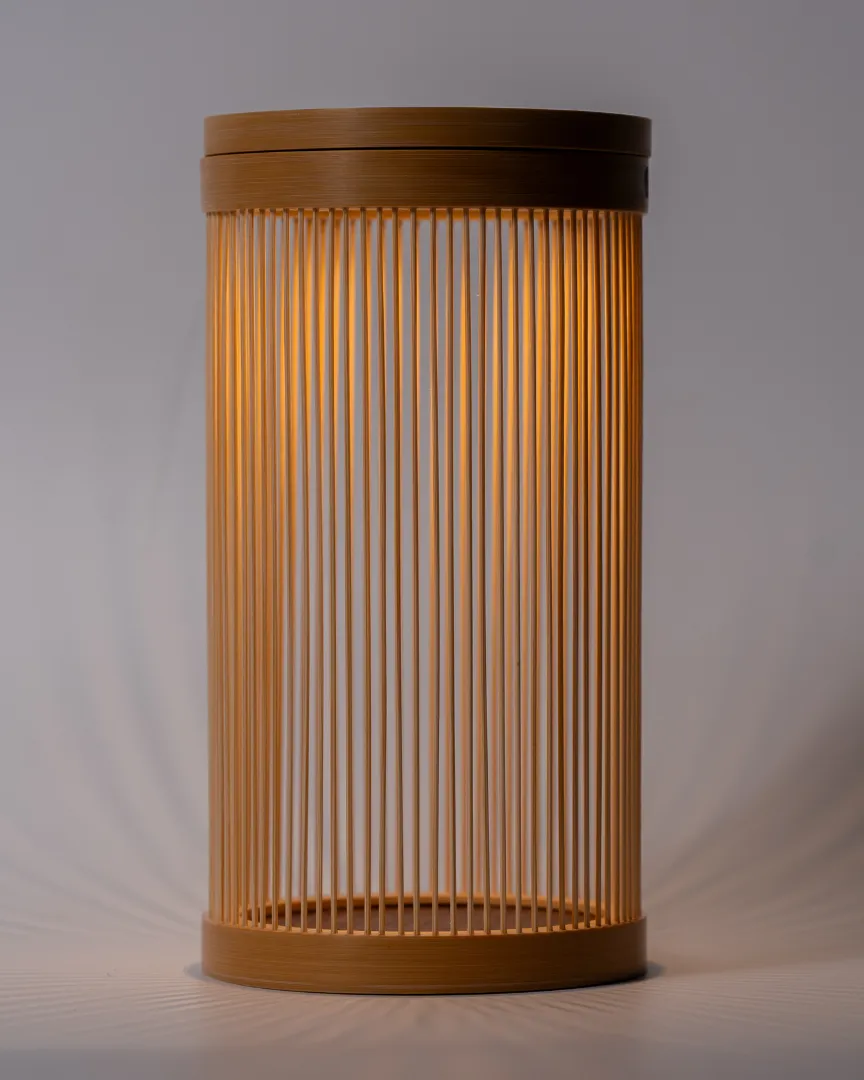
Ultra-fine bamboo strips, made by hand at the Miyabi Andon workshop. At the centre sits the SOMO solar light. In the evening the bamboo lays a pattern of light and shadow across the room.
The Ariake andon
A light from the Edo period
In the Edo period, andon lanterns burned rapeseed oil and a wick. A frame of translucent washi paper kept the wind off the flame.
The Ariake andon had one particular trick: at night the lamp was hung inside the frame, dimmed, as a night light. It takes its name from the Ariake moon, which stays in the sky into the early morning.
The Bamboo Lantern takes up that form. Instead of oil and a wick, the SOMO glows inside — an andon for the 21st century.
Suruga bamboo lattice work
Nearly every step in one pair of hands.
The lantern is made in Suruga Takesensuji Zaiku, a bamboo craft from Shizuoka designated a traditional craft by Japan's Ministry of Economy, Trade and Industry. The Miyabi Andon workshop is a member of the Suruga Bamboo Lattice Craft Association and one of the few workshops still keeping this craft alive. There, nearly every step is done by a single artisan.
-
From bamboo to raw material
Madake and moso bamboo grow for two to three years. They are harvested when long and straight, with wide spaces between the nodes, then de-oiled and dried.
-
Ultra-fine round strips
Cutting, splitting, pulling — hegi, kowari, higohiki. A thousand of these strips side by side, it is said, make the width of a tatami mat.
-
The lantern
Finally the strips become a lantern: stripped, drilled, assembled. Each one turns out one of a kind.

One of a kind
No two are alike.
The small curves and differences in the bamboo are not flaws. They are traces of the light, water and wind it grew with — and they give every lantern its own play of light.
Two continents
Made in Shizuoka. Lit in Johannesburg.
A collaboration between two worlds that could hardly seem further apart at first glance – and yet fit together so well.
 Shizuoka, Japan
The bamboo
In a quiet workshop, artisans work ultra-fine bamboo strips by hand — a technique passed down for generations. Sonnenglas has been glowing in Japan since 2018: first as a light during earthquakes and power cuts, today in homes and cafés across the country.
 Johannesburg, South Africa
The light
We build the SOMO in our Fair-Trade-certified factory in Johannesburg, which runs almost entirely on solar power. People there have steady, fairly paid jobs — in a region where more than 60 percent of young people have none.
In Japan the lantern is called EN, written 縁: connection. The unseen threads between people, cultures and time.
The light inside
Sun by day. Light by night.
The SOMO charges in the sun or via USB-C. To switch it on, line up the magnet in the top of the SOMO with the adjustment dot. The magnetic switch then also turns the light on and off by itself, which saves battery.
More about SOMOIn the shop
With SOMO or without
As a complete set the lantern brings its own light. If you already own a SOMO, you can have the lantern on its own.
-
In the box Bamboo Lantern · SOMO Classic
-
In the box Bamboo Lantern


Frequently asked questions
Line up the magnet in the top of the SOMO with the adjustment dot. The magnetic switch also turns the light on and off by itself to save battery.
In the complete set: the Bamboo Lantern and a SOMO Classic. Without SOMO you get the lantern on its own — if you already own a SOMO.
Natural madake and moso bamboo, made by hand in Shizuoka, Japan.
Because each one is made by hand from natural bamboo. Small curves and differences in the strips belong to it — they make every lantern one of a kind.
The Miyabi Andon workshop in Shizuoka, Japan, in Suruga bamboo lattice work. Nearly every step is done by a single artisan. We build the SOMO in our factory in Johannesburg.
You might also like


Stay in the light
News from our workshop in Johannesburg — a few times a year, honest and short.
Unsubscribe any time with one click. Privacy
 Deutschland
 Österreich
 Schweiz
 United States
 France
 International